1640 Vespers

Posted in News with tags , , , , , , on January 1, 2012 by Craig Zeichner

In 17th-century Italy, vespers (the chief evening service of  the Office, the daily cycle of prayer) were celebrated with lavish music on special feasts. A vespers service contains an introit, five psalms that are framed by chant antiphons, a hymn and the Magnificat. Those are the basics. What composers have done with those psalms, hymns and Magnificat has resulted in some of the most thrilling music of the period.

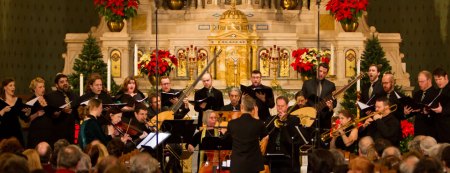
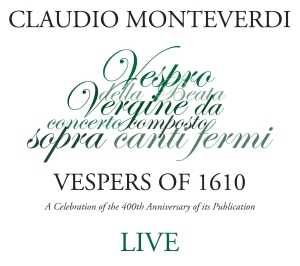
Perhaps the most famous of all Vespers settings is the Vespro della Beata Vergine of Claudio Monteverdi. The Green Mountain Project’s 2010 concert commemorating the 400th anniversary of the publication of Monteverdi’s Vespers was one of the finest performances of the work I’ve ever heard. The Green Mountain Project is a consortium of some of the finest performers on the early music scene and is anchored by Tenet, the excellent New York-based vocal ensemble. Last January the group again presented the 1610 Vespers and released a recording of the 2010 performance. You can buy this marvelous recording at the Tenet website. Here’s what I wrote about it last year.

The 1610 Vespers are on hiatus this year, but on January 3rd, 4th (NY) and 7th (MA)  the Green Mountain Project will present A Grand Festive Vespers in Venice, c. 1640. As much as I adore the 1610 Vespers, this new program has me very excited. Music Director Scott Metcalfe and Artistic Director Jolle Greenleaf have created a Marian Vespers for the Feast of the Conception of the Blessed Virgin, based on the 1610 model. Monteverdi won’t be left by the wayside though, music from his spectacular collection of sacred works Selva morale e spirituale (published 1640/41) will be featured. Fans of the 1610 Vespers will also get to hear his setting of the hymn Ave maris stella. I’m also very excited about the other music on the program too. The Venetian master Giovanni Gabrieli (c. 1555 – 1612) and Milanese composer-nun Chiara Margarita Cozzolani (1602 – c.1676) will also be featured.

I heard Gabrieli here

The inclusion of Gabrieli and Cozzolani is particularly thrilling for me. One of my greatest musical memories was hearing Gabrieli’s music at the Scuola Grande di San Rocco in Venice. Surrounded by Tintoretto paintings we were bathed in Gabrieli’s brilliant polychoral writing. Cozzolani may be the hidden treasure on the program. Her story is remarkable and her music sublime (Robert Kendrick’s excellent essay is a good place to learn more about her). For years I’ve been grabbing any Cozzolani recordings I could find and, thankfully her discography has grown over the years. Who knows? Maybe there’s a Cozzolani Vespers yet to happen. Monteverdi, Gabrieli, Cozzolani and the Green Mountain Project. This one is going to be a winner.

Tickets for all the Green Mountain Project concerts are available on their website.

Here are some highlights of the 2011 performance of the 1610 Vespro della Beata Vergine.

Come to the River

Posted in Reviews with tags , , , , , , , , , , on August 14, 2011 by Craig Zeichner

I’m delighted that early American music continues to enjoy popularity. Definitive recordings by the Boston Camerata and Anonymous 4 put the music on the map and Rose of Sharon, a spectacular 2011 recording by Joel Frederiksen and Ensemble Phoenix Munich, honors it as true American art music. There have also been high-minded and brilliantly performed crossover records like Appalachian Waltz (with the dream team of Yo-Yo Ma, Mark O’Connor and Edgar Meyer), which stressed folk and bluegrass-rooted Americana. Both approaches are valid and welcome. Come to the River by Apollo’s Fire, a period instrument ensemble, weighs in with a decidedly crossover album that will delight fans of that genre and probably put off listeners who are more purist.

The album features a number of New England and Appalachian tunes, Southern spirituals and other traditional tunes in arrangements by Sorrell, ensemble member Paul Shipper and even one by Custer LaRue (a member of the Baltimore Consort, a group who scored big hits with just this kind of crossover). The Apollo’s Fire vocalists all possess polished voices and the instrumentalists perform well. But the spontaneous loose improvisatory style that’s the album’s chief selling point just come across as stiff and corny. I’ve no problem with creative arrangements of old tunes, but ensemble director Jeannette Sorrell’s take on “Nobody But the Baby,” speaks more of the Manhattan Transfer than anything remotely folksy. This is fun, unbuttoned music but the bluesy growls in “Hold on” sound contrived,  and the animal sounds in “Willie, Prithee Goe to Bed” are just embarrassing. When the tone is elevated in a set of Southern spirituals the arrangements don’t work for me. Listen to the studied prettiness of Apollo’s Fire’s  “Wondrous Love” and compare it with versions sung by Anonymous 4 (on Gloryland) or Lydia Brotherton and Ensemble Phoenix Munich (on Rose of Sharon).

There are positives. The purely instrumental pieces have a nice bounce and while they never really push the envelope they are some of the most satisfying performances on the album. Sorrell’s turn at the harpsichord of a set of Dances from New England and Ireland are very nice and made me wish that she played more of them. Some of the Sacred Harp tunes come off quite well too, especially “Return Again/Savior, Visit Thy Plantation.”

At times the concept seems to be at odds with itself though. In the liner notes there’s a half page of text that explains the ensemble has “developed a unique ensemble of crossover artists who specialize in traditional repertoire from early America…they approach the music with the lively freedom of folk performers.” Okay, a looser approach can work. But then there’s the erudite three paragraph discussion of shape-note hymnody where Sorrell seems to snipe at a famous women’s quartet, (who shall remain anonymous) and says, “Performance of shape-note hymns by an all-female quartet is therefore not historical.” Why bring it up? I thought this was supposed to be about “lively freedom?”

How do you actually get to Carnegie Hall?

Posted in News with tags , , on July 28, 2011 by Craig Zeichner

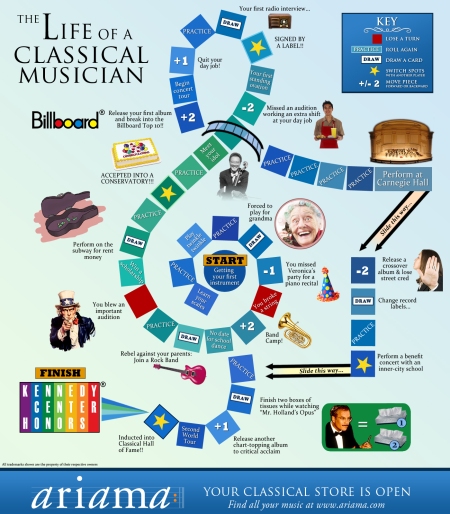
One of the many things I love about my job is working with such clever colleagues. Here’s one of the gems one of them just completed. So, how do you get to Carnegie Hall? Would love to hear from some of you musicians out there.

The life of a classical musician

Yale in New York: Stylus Fantasticus

Posted in News with tags , , , , on April 18, 2011 by Craig Zeichner

I’ve been greatly impressed by the Yale Baroque Ensemble, an outstanding group of young performers in an intensive one-year postgraduate program for string players dedicated to the study and performance of baroque music. The omnipresent (he’s just back from a touring Boston Early Music Festival production, and is performing as concertmaster in New York’s Trinity Baroque Orchestra and Choir’s complete Bach Cantata series) baroque violinist Robert Mealy is the man heading the program and Mealy and company are coming to Zankel Hall on April 25th as part of the eclectic Yale In New York series when they present a program called Stylus Fantasticus.

The program is super juicy:

Dario Castello (fl. early 17c): Sonata decimaquarta (two violins, two cellos, harpsichord from Sonate Concertate in Stil Moderno, Libro II, Venice 1629)

Giovanni Paolo Cima (c. 1570–1622): Sonata a tre (two violins, cello, harpsichord from Concerti Ecclesiastici, Milan, 1610)

Castello: Sonata quarta (two violins, harpsichord)

Giovanni Battista Fontana: (c. 1589–1630): Sonata seconda (violin, harpsichord from Sonate… per il violino, Venice 1641)

Michelangelo Rossi (1602–1656): Toccata settima (harpsichord)

Castello: Sonata decima two violins, cello, harpsichord

Tarquinio Merula (1594–1665): Ballo detto Eccardo & Ciaconna (violins, cello, harpsichord from Canzoni ovvero Sonate Concertate, Libro III, Venice 1637)

Johann Rosenmüller (1619–1684): Sonata quarta (two violins, cello, harpsichord
from Sonate a 2, 3, 4, 5 stromenti d’arco, Nuremburg 1682)

Intermission

Heinrich Ignaz Franz von Biber (1644–1704): Battalia (full ensemble)

Johann Heinrich Schmelzer: (1620–1680): Sonata a tre violini (three violins, continuo)

Johann Jakob Froberger (1616–1667): Toccata (harpsichord)

Schmelzer: Sonata quarta (violin, harpsichord from Sonate unarum fidium, Vienna 1664)

Henry Purcell (1659¬–1695): Three Parts upon a Ground (full ensemble)

Arcangelo Corelli (1653–1713): Concerto Grosso in D major, Op. 6, No. 4 (full ensemble)

Tickets are available at the Carnegie Hall website and at the box office.

Victoria

Posted in News with tags , , , , , on March 2, 2011 by Craig Zeichner

There should be more of a hubbub about the Victoria anniversary year. As a matter of fact, you might not have even known that 2011 is the 400th anniversary of the death of Tomás Luis da Victoria, the finest of all Spanish composers.

It’s an interesting coincidence that Victoria (1548 – 1611) was born in Ávila, the hometown of St. Teresa (1515 – 1582), the great Christian mystic. Victoria’s music has a spiritual intensity that puts him in a unique place and to my mind only Bach, Messiaen and John Coltrane achieve similar results. For me, Victoria sits comfortably in the company of St. Teresa.

Bernini's "The Ecstasy of Saint Teresa"

And with El Greco too. A contemporary of Victoria (El Greco’s dates are 1541 – 1614), his paintings capture in oils and canvas what Victoria’s does with music.

El Greco's "Assumption of the Virgin"

I hear Victoria’s Marian music with its bright, heaven-bound, lighter-than-air qualities and my brain references El Greco’s work. Both masters have a straight-to-the-heart, take-no-prisoners appeal that leaves no middle ground. Listen to the Victoria Requiem or Tenebrae Responses and El Greco’s dark, pained skies and suffering Saints come to mind.

El Greco's "Christ Carrying the Cross"

I first heard Victoria during a Good Friday service at St. Ignatius of Antioch Episcopal Church in NY about 20 years ago. The choir was singing his Popule meus during the veneration of the cross. It’s one of the pieces Victoria included it in a massive publication called Officium Hebdomadae Sanctae which includes nine Lessons from the Lamentations of Jeremiah the Prophet, hymns, settings of the Passion and other music. Published in Rome in 1585, it is the most complete collection of music for Holy Week ever created.

Victoria’s Lamentations of Jeremiah for Maundy Thursday are going to be sung by TENET, the superb vocal ensemble on March 19th at that very St. Ignatius of Antioch Church where I had my Victoria epiphany. This is going to be an outstanding program because in addition to Victoria, TENET is singing works by Cristobal de Morales (c. 1500 –1553), Francisco Guerrero (1528-1599) and a selection from the Llibre Vermell de Montserrat (13th c.). If you don’t know the music of the Spanish Siglos de Oro, you are in for a revelation. Morales was the most important Spanish composer before Victoria and Guerrero always surprises, a composer skilled in both sacred and secular music.

Tickets are available from TENET and can also be purchased the night of the concert. Past experience with TENET concerts means you would do well to order now, St. Ignatius fills up rather quickly.

Tributes: Elegies and Homages

Posted in News with tags , , , , on February 5, 2011 by Craig Zeichner

Portrait of Tymotheos, (perhaps Gille Binchois) by Jan Van Eyck (c.1432).

I’m always excited when the excellent vocal ensemble TENET has an upcoming concert. Their concerts have that elusive mix of brilliant programming wed to stunning artistry. I’ve been knocked out by this ensemble since the first time I heard them and right now I think they are the best mixed voice ensemble in town. Kudos to artistic director Jolle Greenleaf for shaping such an ensemble and having such a good nose for repertoire. On February 12th the group will sing a program of elegies and homages spanning the 15th to 20th centuries. What makes this really enticing is the mix of repertoire and the way the repertoire relates: a motet by Binchois sets the table for Ockeghem’s Mort tu as navrè de ton dart, a work that mourns the death of Binchois. Ockeghem then becomes the subject of Josquin Des Prez’s memorial Nymphes des bois. The clever game of funereal tag continues with music by Clemens non Papa (how I love that name!), Jacobus Vaet, Thomas Tallis and William Byrd — and that’s just the Renaissance music!

The blessed Josquin.

The second half of the program serves up brilliant 19th and 20th century English choral homages by Parry, Stanford, Vaughan Williams and Howells. If you give a fig about beautiful choral music you are going to love these works.

TENET is the core group at the heart of those spectacular Green Mountain Project Monteverdi Vespers performances we’ve been treated to for the past two years, so this is going to be one of the year’s best. John Scott, Director of Music at Saint Thomas Church, is the guest conductor and if you know anything of the repertoire they sing at St. Thomas, you know Scott has this music in his blood.

You can order tickets for this and other TENET concerts (they have a Spanish Renaissance program and Bach and His Predecessors concert on the horizon) at their website.

One more thing. TENET’s concerts are held at St. Ignatius of Antioch Episcopal Church, one of the city’s most beautiful churches and one of my very favorite places to hear this music. The church is bound to fill up quickly, so I suggest getting your tickets ASAP.

Buxtehude won’t be on the February 12th program, but here’s TENET in his heart-stopping Jesu, meines Lebens Leben.

An Epiphany Gift

Posted in Reviews with tags , , , , , , , on January 13, 2011 by Craig Zeichner

On the liturgical calendar, the Feast of the Epiphany is celebrated 12 days after Christmas. But it took the combined efforts of the Spanish and U.S. postal services over a month to deliver my copy of the Glossa recording of Cristofaro Caresana’s L’Adoratione de’Magi. Glossa posted it on December 1st and it arrived early this week. No matter, I treasure the recording as much as if it were gifts of gold, frankincense and myrrh.

My cd is somewhere in there

L’Adoratione de’Magi is a collection of three delightful Christmastide cantatas by the little-known Neapolitan composer Caresana (c.1640 – 1709). Of course, Caresana and Antonio Florio’s Cappella della Pietà de’Turchini share some history together. It was I Turchini (as they are now known) who resurrected the music of Caresana and other forgotten Neapolitan masters like Provenzale, Latilla and Vinci through a series of recordings called Tesori di Napoli on the Symphonia, Opus 111 and Eloquentia labels. Things change. Symphonia has all but disappeared, Eloquentia is extremely difficult to find and Opus 111 was absorbed by Naïve. Unfortunately, Naïve never seemed to get behind the series.

Glossa Music wisely snatched up I Turchini and the Caresana recording is the first in what I hope is a long and fruitful relationship between the label and the ensemble. I first encountered Caresana on a spectacular Opus 111 recording called Per la Nascita del Verbo, a Neapolitan Christmas music collection. This marvelous music is completely unaffected, marvelously raucous and sweetly melodic. The same can be said for what’s on L’Adoratione de’Magi.

A Neapolitan treasure indeed!

The music has an earthy, folk-like flavor. Dance rhythms pop up and blend nicely with the honeyed melodic lines. Think of your favorite rustic Italian dance whirling around arias by Alessandro Scarlatti and you’ll have an idea of what’s offered in the cantata La Veglia, and be sure to linger over “Dormi o ninno,” one of the most beautiful lullabies ever written.

I love the broad strokes with which the characters are painted. Lucifer is a bellowing lout (boisterously sung by bass Giuseppe Naviglio) in Demonio, Angelo e Tre Pastore, a comic verbal sparring match between angels and a demon and shepherds (who express their joy with a lovely dance to end the cantata). The spirit of the commedia dell’arte hovers over all and the result is delicious.

Commedia dell’arte hijinks

It’s not all high spirits though. These works were very much products of the counter-reformation and served a didactic function. I was especially struck by the pained, plunging chromaticism on a phrase one of the Magi sings in the title cantata as he presents the gift of myrrh and refers to the sacrifice the infant will make as an adult.

The Magi and the infant

There’s also a solo voice cantata honoring San Gennaro, Sembri Stella Felice, Partenope Leggiadra. San Gennaro is the patron saint of Naples and his chief feast days fall in May, September and December, so the cantata is not out of place on a Christmas record and is a stirring snapshot that captures the essence of devotion in the 17th-century city. Rounding out the recording are two sonatas for strings by Pietro Andrea Ziani, which provide nice contrast between the cantatas.

The performances are all outstanding and feature many of the singers who have made the Tesori di Napoli series one of the best ever made. The liner notes are by Dinko Fabris who knows more about this music than any living soul. Nobody performs this music with the same skill and exuberance as I Turchini and I rejoice that Glossa was smart enough to pick them up.

Celebrate Epiphany and get this one now!

Baroque baddies

Posted in News with tags , , , on December 21, 2010 by Craig Zeichner

He could be a bass singing a da capo aria.

I just read a great review by Stephen Rice of the Glossa recording of William Hayes’ The Passions, an ode for music in the current issue of Oxford’s Early Music. One spectacular line stood out, “Basses usually get to sing the best baddies, Baroque composers reaching for low notes when nastiness is required with the predictability of Hollywood casting director speed-dialing Alan Rickman.” Brilliant!

Who are some of your favorite Baroque baddies? Please share.

Another gem from Glossa.

Best of 2010

Posted in Reviews with tags , , , , , , , , , , , , , , , , , , on December 16, 2010 by Craig Zeichner

It’s been a pretty good year for early music recordings with self-produced projects and indie label releases rising to the top of the class. Two New York-based ensembles won glory this year and recordings on the ATMA Classique label proved that Montréal is an early music capitol city. Here’s some of the best, what were your favorites?

Claude-Bénigne Balbastre: Music for Harpsichord
Elizabeth Farr, harpsichord
(Naxos)

Farr plays a big Keith Hill harpsichord with two buff stops and makes a great case for this music which balances wit with tenderness.


I Mercanti Di Venezia

La Bande Montréal
Eric Milnes, director
(ATMA Classique)

This is a superb recording of music by Jewish composers in Italy. It’s performed by an ensemble of A-list players from the city which has supplanted Boston as the epicenter of North American early music.

Monteverdi: Vespro della Beata Vergine
Green Mountain Project
Jolle Greenleaf and Scott Metcalfe, directors
(Green Mountain Project)

This was one of the most inspiring stories of the year, a recording by a handful of super-dedicated musicians who mounted a production of the Vespers to celebrate the work’s 400th anniversary. They performed the work on January 3rd, in what was probably the first performance of the Vespers in the anniversary year. By the way, it’s one of the very best recordings of the Vespers out there.

You can order directly from the Green Mountain Project and proceeds will help these folks repeat the performance on January 2, 2011.

O Praise the Lord, Restoration Music from Westminster Abbey
Westminster Abbey Choir
James O’Donnell, director
(Hyperion)

Hyperion’s ongoing series with the Westminster Abbey Choir has been uniformly superb. This one has music by John Blow, Henry Purcell and some lesser-known Restoration composers.


Peter Philips: Cantiones Sacrae 1612

Choir of Trinity College, Cambridge
Richard Marlow, conductor
(Chandos)

The Cantiones Sacrae are scored for five voices and glow with spiritual fervor and melodic beauty. The excellent Choir of Trinity College, Cambridge under the direction of Richard Marlow are marvelous.


Rosso, Italian Baroque Arias

Patricia Petibon, soprano
Venice Baroque Orchestra
Andrea Marcon, director
(DG)

Petibon is ideal in these high-flying showpieces by Handel, Scarlatti, Porpora and others.

Johann Hermann Schein: Opella Nova
Sagittarius
Michel Laplénie, director
(Editions Hortus)

Schein was one of the first German Protestant composers to assimilate the Italian style and write vocal concertos based on German chorale tunes—that’s a tasty blend! The French ensemble Sagittarius is superb and I hope they continue to record more of Schein’s music.

Senza Continuo
Margaret Little, viola da gamba
(ATMA Classique)

When I reviewed this one earlier this year I wrote, “I’ve never heard a bad recording involving viola da gambist Margaret Little.” I stand by the statement, this recording of works by English, French and Italian composers is essential listening.

John Sheppard: Media vita
Stile Antico
(Harmonia Mundi)

Audiences and critics have been tripping over themselves dishing out praise for this excellent ensemble and the truth is Stile Antico delivers as promised. Their vocal blend and tonal quality are brilliant, the clarity of their singing is top-flight.

Tudor City
New York Polyphony
(Avie)

While the Stile Antico love-fest/press blitz was rolling along, you might have missed Tudor City. I hope you didn’t, because this is a superb album, the best recording of early vocal music of the year. Worcester Fragments, Eton Choirbook music, Dunstable, Byrd, Tallis, Tye and Smith all sit together so well and the performances are stunners.

Charpentier’s Messe de Minuit

Posted in News with tags , , , , , , on December 6, 2010 by Craig Zeichner

Charpentier’s Messe de Minuit was the first piece of French baroque music that I ever encountered. Sir David Willcocks’ with the Kings College Choir, Cambridge and the English Chamber Orchestra on Angel was the first recording of the piece that I owned and many years later it remains a favorite.

Charpentier’s use of traditional French noëls gives the work its unique charm. Here’s a terrific post about the piece on this from the Magnificat blog, hopefully we will get a Magnificat recording of it some day.

Follow

Get every new post delivered to your Inbox.